Blood pressure, wearables, and FDA General Wellness Guidance: did the rules really change?
In July 2025, the FDA issued a warning letter to WHOOP, stating that measuring blood pressure is a medical device function. But in January 2026, they updated their guidance. What changed? Do the new guidelines really allow wearables to measure blood pressure without regulation or evidence?
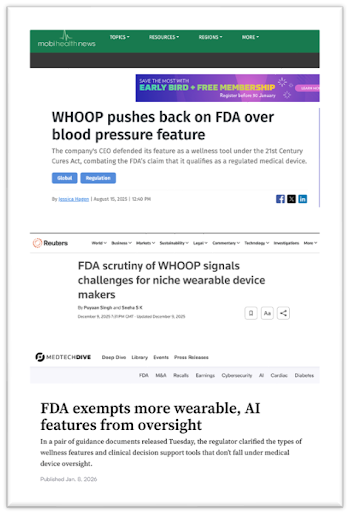
The short answer is not really, at least not in the way most people interpret “measuring blood pressure”.
What the FDA actually said to WHOOP
In its warning letter to WHOOP, the FDA made clear that WHOOP’s feature was problematic because it appeared to be providing information about blood pressure, a clinical vital sign, without adequate evidence or regulatory clearance. The following quote was taken directly from the letter:
“Based on FDA's evaluation of BPI's (Blood Pressure Insights) intended use, the product is intended to provide a measurement or estimation of a user's blood pressure, which is inherently associated with the diagnosis of hypo- and hypertension, and is therefore intended for use in the diagnosis of a disease or other condition, or in the cure, mitigation, treatment, or prevention of disease.”
So regardless of how the feature was framed or positioned, the FDA viewed the functionality itself as crossing the boundary from general wellness into regulated medical device territory under.
On January 23, 2026, the FDA issued a draft guidance “Cuffless Non-Invasive Blood Pressure Measuring Devices – Clinical Performance Testing and Evaluation” which clarifies in detail the level of clinical evidence expected for cuffless blood-pressure devices that are considered medical devices, and are not exempt under the FDA’s General Wellness policy.
FDA’s updates to its General Wellness Policy Guidance
One paragraph in particular in the updated General Wellness policy has caused some confusion:
“FDA may consider certain products that use non-invasive sensing (e.g. optical sensing) to estimate, infer, or output physiologic parameters (e.g. blood pressure, oxygen saturation, blood glucose, heart rate variability) to be general wellness products when such outputs are intended solely for wellness uses”
This might sound like a green light: blood pressure is listed, so wearables can now measure blood pressure without regulation. But that interpretation ignores everything that follows.
The FDA did not say: “You can now measure blood pressure and be exempt from regulation.” What it said was conditional clarifying that blood pressure may be a non-medical device measurement “when such outputs are intended solely for wellness uses, and provided they… do not include values that mimic those used clinically unless validated (e.g. manufacturer testing, peer-reviewed clinical literature) to reflect those values”.
These conditions quietly but fundamentally change the landscape. Blood pressure, as clinicians understand it, is defined by numbers (mmHg), thresholds, and clinical interpretation (e.g. hypertension, hypotension). If a wearable outputs something that looks like that, even if it’s labelled “for wellness only”, the FDA maintains you need evidence to back it up.
What wearables can and can’t do under the new guidance
The new FDA guidance does allow an increased degree of flexibility for products that meet the “general wellness” criteria. Such devices may display values, ranges, trends, baselines, or longitudinal summaries of user data without triggering medical device regulation.
However, this flexibility has limits. A product that is not regulated as a medical device must not reference specific diseases, clinical conditions, or diagnostic thresholds.
Importantly, the FDA does permit the inclusion of certain general safety nudges. For example, a device may notify users that seeking evaluation by a healthcare professional may be helpful when outputs fall outside ranges appropriate for general wellness use. These notifications are permitted only under strict conditions such as not including clinical thresholds, diagnoses, or treatment recommendations.
Another change introduced in the update is that labelling and communication now matter more. The FDA has placed explicit emphasis on how products intended for general wellness use are described and presented to users, stating that it expects such products to have labelling (instructions for use, user-facing claims, promotional materials, and marketing communications) that is consistent with the product’s stated intended use. This adds an additional layer of user protection by requiring companies to be transparent and consistent in how they frame their claims at every point.
Where we actually are, despite all the headlines
Despite all the attention around this topic, you might be surprised to learn that (at the time of writing) none of the major consumer wearables currently measure blood pressure.
WHOOP is currently the only major wearable platform that offers users “Blood Pressure Insights” as a beta feature. WHOOP does not directly measure blood pressure; instead, it infers blood pressure trends using a machine learning model that integrates physiological signals such as heart rate, heart rate variability (HRV), photoplethysmography (PPG), and user-entered reference values, providing trend-level estimates rather than absolute blood pressure measurements. Under the updated general wellness policy from the FDA, features such as WHOOP’s Blood Pressure Insights - if they continue to mimic clinical values - will require validation before progressing beyond the beta phase.
Other major players, including Apple, have publicly signalled interest in cuffless blood pressure measurement for several years but have repeatedly delayed product release. This strongly suggests a shared technical challenge across the industry: achieving direct, accurate, and non-invasive blood pressure measurement using wrist-worn technology remains difficult.
The risk of foreseeable use remains
Despite these changes, the reality is that users will continue to use the information provided by products in ways they personally find most useful.
If users diagnosed with hypertension own a wearable that claims to measure blood pressure, even with safeguards in place, they are likely to use it to judge whether their blood pressure is within a healthy range. That is normal human behaviour. In this scenario, validated, clinically recognisable blood pressure values are more useful and safer for users than vaguely defined, non-clinical metrics that have not been validated.
The bottom line
The FDA has not completely opened the door to unregulated blood pressure measurement in wearables. Instead, it has clarified the grey zone: wellness positioning does not remove the requirement to validate outputs that resemble clinical values.
If your company is navigating complex scientific or regulatory pathways for a digital health product, Hardian Health can help. Get in touch to discover how our expertise can support your journey from concept to clearance.